


Have you heard of Write the Room?
If you’re looking for engaging, low-prep Write the Room activities that get children moving while building essential reading and writing skills, this classroom favorite is perfect for kindergarten and first grade literacy centers. 🌈
Unlike traditional seatwork, Write the Room combines movement, hands-on learning, vocabulary development, visual discrimination, and handwriting practice into one highly motivating activity. Even better? Students often see it as a game rather than work. These Write the Room activities for kindergarten are ideal for literacy centers, morning tubs, early finisher work, small groups, and independent practice.
In this post, we’re sharing 6 powerful reasons why Write the Room works so well in kindergarten and first grade classrooms—and why students get excited every time you pull out the clipboards. ✏️
📚 What Are Write the Room Activities?
Write the Room is an interactive literacy center where students search the classroom for vocabulary cards, words, pictures, or learning targets posted around the room. Once they find each card, they record the matching word or response on a recording sheet.
The activity can be adapted for:
- Letter identification
- Beginning sounds
- CVC words
- Sight words
- Seasonal vocabulary
- Science and social studies themes
- Phonics skills
- Sentence building
- Vocabulary development
Because it is so flexible, Write the Room can be used throughout the entire school year while targeting specific learning goals.
🚶 Reason #1: Write the Room Activities Get Kids Moving
Children are not designed to sit still for long periods of time. Young learners naturally learn through movement, exploration, and interaction.
Write the Room gives students a purposeful reason to move around the classroom. As they travel from card to card, students remain actively engaged in the learning process.
Benefits of movement-based learning include:
- Increased student engagement
- Improved focus and attention
- Greater motivation to participate
- Opportunities to release energy in productive ways
- Support for kinesthetic learners
Instead of asking students to stay seated while practicing literacy skills, Write the Room allows them to learn while moving, which often leads to higher levels of participation and excitement.
🧩 Reason #2: Hands-On Learning Creates Stronger Connections
Children learn best when they actively participate in their learning.
With Write the Room, students are not simply looking at a worksheet. They are:
- Searching for information.
- Matching visuals and words.
- Recording responses independently.
- Reviewing vocabulary multiple times.
This active involvement helps students make stronger connections to the content and encourages independent learning habits.
✏️ Reason #3: Write the Room Activities Build Handwriting Practice
Writing still matters.
While digital tools have their place, young learners need frequent opportunities to practice forming letters and words correctly.
Every Write the Room activity includes meaningful writing practice. Students repeatedly record letters, words, or vocabulary terms, helping them build:
- Letter formation skills
- Fine motor development
- Pencil control
- Proper handwriting habits
- Writing stamina
Best of all, students are often so focused on the scavenger-hunt aspect of the activity that they don’t even realize they’re getting extra writing practice.
🔍 Reason #4: Visual Discrimination Skills Matter
Visual discrimination is the ability to notice similarities and differences between letters, words, symbols, and images.
This skill plays an important role in early literacy development.
During a Write the Room activity, students must carefully examine cards and distinguish between similar letters, words, and pictures.
💬 Reason #5: Write the Room Activities Strengthen Vocabulary
One of the greatest advantages of Write the Room is its ability to focus on specific vocabulary.
Whether you are teaching alphabet words, seasonal themes, science concepts, community helpers, or phonics patterns, Write the Room allows students to repeatedly interact with important vocabulary in meaningful ways.
Benefits of targeted vocabulary instruction include:
- Increased word recognition
- Better comprehension
- Improved oral language development
- Stronger reading readiness skills
- Greater confidence when encountering new words
Repeated exposure through movement and writing helps students retain vocabulary more effectively than simply memorizing a word list.
🌟 Reason #6: Students Love Feeling Like Big Kids
Let’s be honest. Part of the magic of Write the Room has nothing to do with literacy standards.
Children love carrying a clipboard.
Hand a student a clipboard, recording sheet, and pencil, and suddenly they feel important. They feel responsible. They feel grown up.
For many students, this simple change transforms a literacy task into an exciting mission.
And really, what kiddo doesn’t love feeling grown up with a clipboard and pencil? 😊
❤️ Why Teachers Love Write the Room
Teachers appreciate Write the Room because it combines multiple learning objectives into a single activity.
With one center, students can practice reading, writing, vocabulary, letter recognition, visual discrimination, fine motor skills, and independent work habits—all while having fun.
It’s a win for everyone.
🛍️ Our Favorite Write the Room Resources
If you’re ready to bring engaging movement-based literacy activities into your classroom, these teacher favorites make it easy.
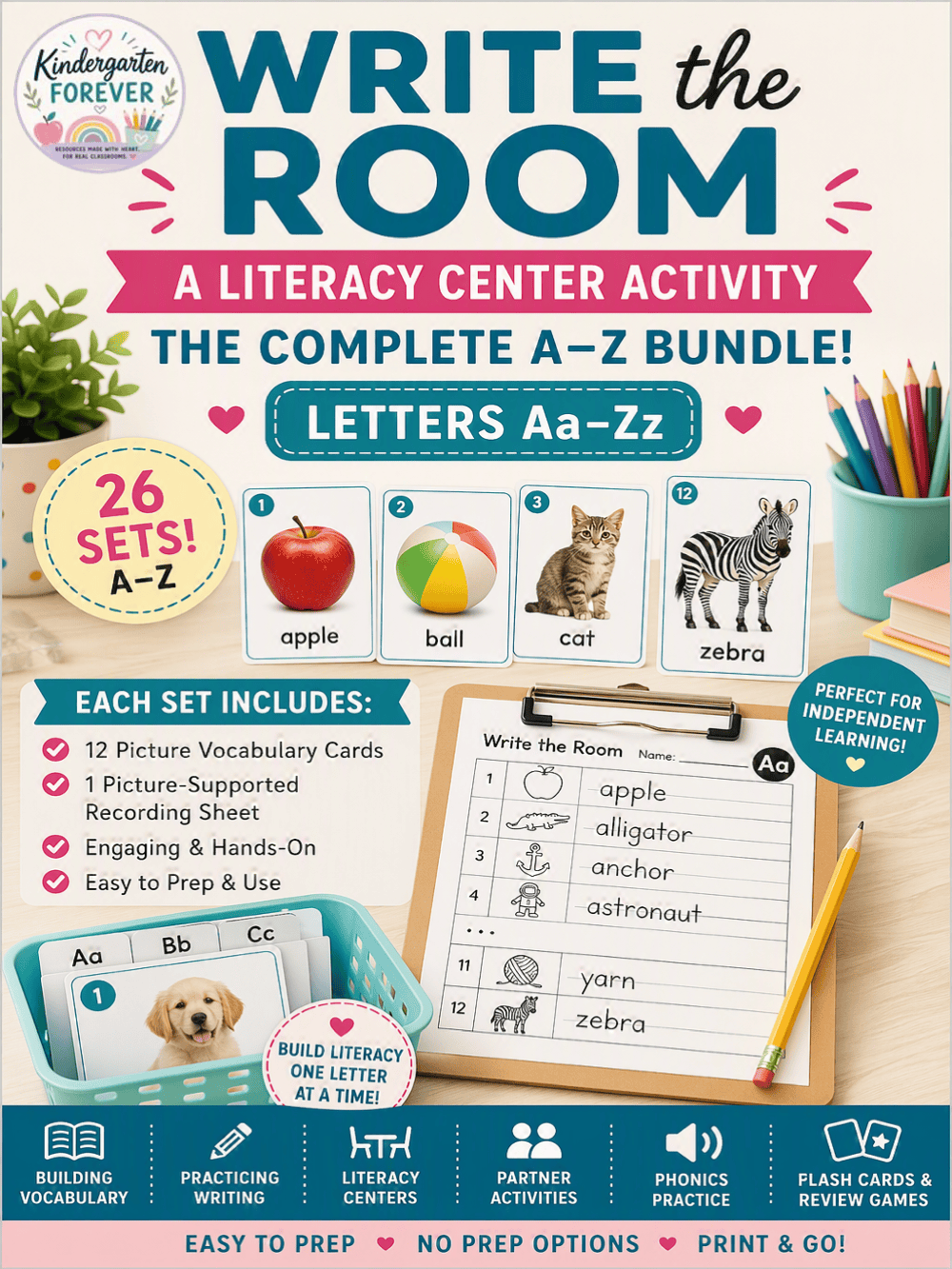
🔤 A-Z Write the Room Bundle
Build alphabet knowledge and early literacy skills with an engaging collection of alphabet-focused Write the Room activities. With a set for letters A-Z, it doesn’t matter which order you teach the letters to your class. The images focus on the beginning sounds for each letter – except X, where we use endings too 😉 With realistic pictures, your little learners will love this set; it will make your classroom feel modern and connected.

📅 Year-Long Write the Room Bundle
Keep literacy centers fresh all year long with seasonal and thematic Write the Room activities designed to support vocabulary growth, reading development, and independent learning throughout the school year. What’s included? Themed sets for the whole year: Back to School, Fall, Hallowe’en, Thanksgiving (appropriate for both the US and Canada), Winter, Christmas, New Year’s, Valentine’s Day, St. Patrick’s Day, Easter, Spring, and Summer.
🎉 Final Thoughts
Write the Room is more than just a literacy center. It is a purposeful learning experience that combines movement, hands-on practice, visual discrimination, vocabulary development, and handwriting skills in a way that students genuinely enjoy.
When children are engaged, moving, and actively participating, learning becomes meaningful.
That’s exactly why Write the Room continues to be one of the most effective and beloved literacy activities for kindergarten and first grade classrooms.
❓ Write the Room Activities FAQ
What are Write the Room activities?
Write the Room activities are interactive literacy center activities where students move around the classroom, find cards, and record words, letters, or answers on a recording sheet.
Are Write the Room activities good for kindergarten?
Yes! Write the Room activities for kindergarten are great for building letter recognition, beginning sounds, vocabulary, handwriting, visual discrimination, and independent work habits.
How do you use Write the Room in literacy centers?
Add the cards around the room, give students a recording sheet, clipboard, and pencil, and let them search, read, write, and record their answers independently.
What skills do Write the Room activities practice?
Write the Room can support alphabet practice, phonics skills, sight words, vocabulary development, handwriting, visual discrimination, and fine motor skills.