
The Ontario Primary Curriculum is designed to build strong, confident learners from Grades 1–3. These early primary years form the bridge between play‑based kindergarten and the more formal academic expectations of junior grades. Understanding how the curriculum progresses—and how each subject deepens year over year—helps teachers plan intentionally, differentiate effectively, and feel grounded in what truly matters.
In this post, you’ll find a clear, teacher‑friendly breakdown of how the Ontario Primary Curriculum grows across Grades 1–3, how English and French Immersion expectations align, and how to plan your year using long‑range plans and tracking documents. This is evergreen guidance you can return to every September.
Table of Contents
📘 How the Ontario Primary Curriculum Progresses from Grade 1 to Grade 3
The Ontario Primary Curriculum is structured to gradually increase independence, complexity, and skill mastery. While each grade has its own expectations, the progression is intentionally smooth.


Language (English Program)
Across Grades 1–3, students move from foundational literacy skills toward more sophisticated reading, writing, and oral communication.
- Grade 1 focuses on decoding, phonemic awareness, high‑frequency words, simple sentence writing, and listening comprehension.
- Grade 2 strengthens fluency, expands vocabulary, introduces paragraph writing, and builds confidence in expressing ideas orally.
- Grade 3 transitions students toward reading for meaning, writing with structure and purpose, and engaging in deeper discussions.
The Ontario Primary Curriculum emphasizes explicit instruction, daily reading and writing opportunities, and ongoing assessment to support literacy growth.

French Immersion Language
In French Immersion, the curriculum follows the same developmental arc—but with language acquisition layered on top.
- Grade 1 FI introduces foundational oral language, basic vocabulary, phonological awareness, and simple written structures.
- Grade 2 FI expands reading fluency, comprehension strategies, and structured writing.
- Grade 3 FI moves toward more complex texts, multi‑paragraph writing, and confident oral communication.
The Ontario Primary Curriculum ensures that French Immersion students develop literacy skills that parallel the English program while building strong bilingual foundations.

Mathematics
Math expectations progress in predictable, manageable steps across the primary grades.
- Grade 1 builds number sense to 100, early addition/subtraction, patterning, measurement basics, and simple data collection.
- Grade 2 extends number sense to 200, introduces multiplication concepts, strengthens problem‑solving, and deepens geometry and measurement.
- Grade 3 moves into multiplication/division facts, fractions, more complex problem‑solving, and expanded data management.
The Ontario Primary Curriculum encourages hands‑on learning, math talk, and real‑world problem‑solving.

Science & Technology
Science grows from exploration to structured inquiry.
- Grade 1 focuses on living things, materials, energy, and movement.
- Grade 2 explores growth and changes, properties of liquids/solids, movement, and air/water.
- Grade 3 introduces forces, strong/ stable structures, plants, and soils.
The Ontario Primary Curriculum supports curiosity, experimentation, and inquiry‑based learning.

The Arts
Visual arts, drama, dance, and music progress in complexity and creativity.
- Grade 1 emphasizes exploration and expression.
- Grade 2 builds technique and intentionality.
- Grade 3 encourages students to create with purpose, reflect, and refine.

Health & Physical Education
Across Grades 1–3, students develop physical literacy, healthy living skills, and social‑emotional awareness.
The Ontario Primary Curriculum ensures students build confidence, cooperation, and lifelong wellness habits.
🗂️ How to Plan for Your Grade Using Long‑Range Plans
A strong long‑range plan is the backbone of a calm, organized year. Whether you teach Grade 1, Grade 2, or Grade 3, your planning should reflect the natural progression of the Ontario Primary Curriculum.
A high‑quality LRP helps you:
- Map out curriculum expectations month‑by‑month
- Ensure balanced coverage across subjects
- Build predictable routines
- Reduce last‑minute planning stress
- Align assessment with instruction
If you teach Grade 1 or Grade 2, you can use our fully built long‑range plans to guide your year. If you teach Grade 3, completing your LRP ensures your planning is just as streamlined and intentional.
📊 Using Tracking Documents to Stay Organized All Year
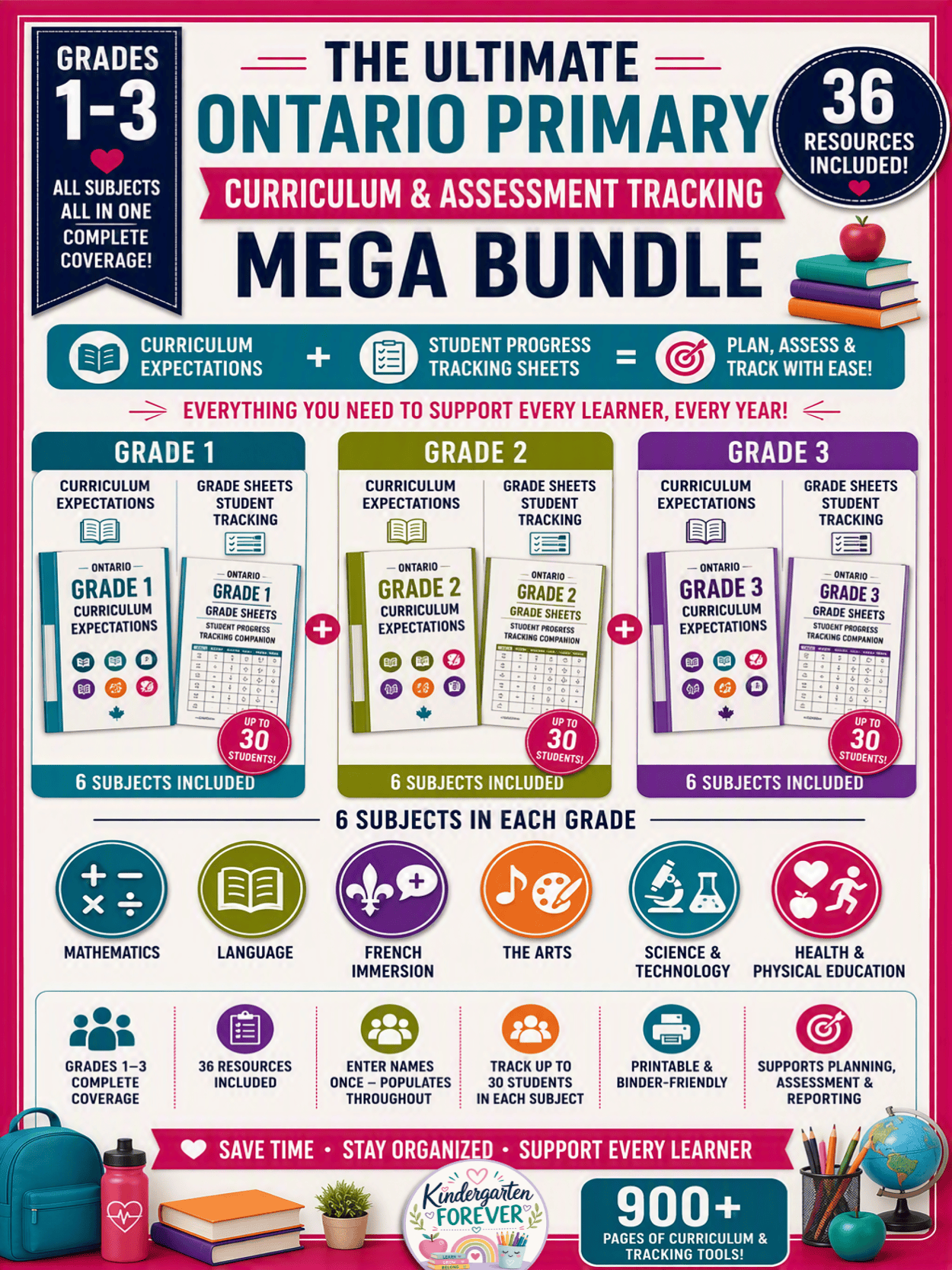
Tracking documents are essential for staying aligned with the Ontario Primary Curriculum. They help you monitor expectation coverage, assessment data, and student progress.
A strong tracking system allows you to:
- See exactly which expectations you’ve taught
- Identify gaps before reporting periods
- Track accommodations and modifications
- Keep assessment evidence organized
- Support differentiated instruction
Our tracking documents are designed to pair seamlessly with your long‑range plans, giving you a complete planning and assessment ecosystem.
🔗 Explore More Primary Teaching Resources
If you’re building out your year, you can explore a full collection of primary teaching tools, printables, and curriculum‑aligned resources on our Primary Resources page. You’ll find materials designed to support the Ontario Primary Curriculum across Grades 1–3, including literacy, math, French Immersion, science, arts, and classroom management essentials.
🌟 Final Thoughts
Teaching Grades 1–3 is a rewarding journey. When you understand how the Ontario Primary Curriculum progresses—and when you have strong long‑range plans and tracking documents—you can teach with clarity, confidence, and purpose. Your students feel that stability, and your classroom becomes a place where learning flows naturally.