✨ 6 Reasons Write the Room Activities Are a Kindergarten Literacy Favorite

Have you heard of Write the Room?

If you’re looking for engaging, low-prep Write the Room activities that get children moving while building essential reading and writing skills, this classroom favorite is perfect for kindergarten and first grade literacy centers. 🌈

Unlike traditional seatwork, Write the Room combines movement, hands-on learning, vocabulary development, visual discrimination, and handwriting practice into one highly motivating activity. Even better? Students often see it as a game rather than work. These Write the Room activities for kindergarten are ideal for literacy centers, morning tubs, early finisher work, small groups, and independent practice.

In this post, we’re sharing 6 powerful reasons why Write the Room works so well in kindergarten and first grade classrooms—and why students get excited every time you pull out the clipboards. ✏️

📚 What Are Write the Room Activities?

Write the Room is an interactive literacy center where students search the classroom for vocabulary cards, words, pictures, or learning targets posted around the room. Once they find each card, they record the matching word or response on a recording sheet.

The activity can be adapted for:

  • Letter identification
  • Beginning sounds
  • CVC words
  • Sight words
  • Seasonal vocabulary
  • Science and social studies themes
  • Phonics skills
  • Sentence building
  • Vocabulary development

Because it is so flexible, Write the Room can be used throughout the entire school year while targeting specific learning goals.

🚶 Reason #1: Write the Room Activities Get Kids Moving

Children are not designed to sit still for long periods of time. Young learners naturally learn through movement, exploration, and interaction.

Write the Room gives students a purposeful reason to move around the classroom. As they travel from card to card, students remain actively engaged in the learning process.

Benefits of movement-based learning include:

  • Increased student engagement
  • Improved focus and attention
  • Greater motivation to participate
  • Opportunities to release energy in productive ways
  • Support for kinesthetic learners

Instead of asking students to stay seated while practicing literacy skills, Write the Room allows them to learn while moving, which often leads to higher levels of participation and excitement.

🧩 Reason #2: Hands-On Learning Creates Stronger Connections

Children learn best when they actively participate in their learning.

With Write the Room, students are not simply looking at a worksheet. They are:

  1. Searching for information.
  2. Matching visuals and words.
  3. Recording responses independently.
  4. Reviewing vocabulary multiple times.

This active involvement helps students make stronger connections to the content and encourages independent learning habits.

✏️ Reason #3: Write the Room Activities Build Handwriting Practice

Writing still matters.

While digital tools have their place, young learners need frequent opportunities to practice forming letters and words correctly.

Every Write the Room activity includes meaningful writing practice. Students repeatedly record letters, words, or vocabulary terms, helping them build:

  • Letter formation skills
  • Fine motor development
  • Pencil control
  • Proper handwriting habits
  • Writing stamina

Best of all, students are often so focused on the scavenger-hunt aspect of the activity that they don’t even realize they’re getting extra writing practice.

🔍 Reason #4: Visual Discrimination Skills Matter

Visual discrimination is the ability to notice similarities and differences between letters, words, symbols, and images.

This skill plays an important role in early literacy development.

During a Write the Room activity, students must carefully examine cards and distinguish between similar letters, words, and pictures.

💬 Reason #5: Write the Room Activities Strengthen Vocabulary

One of the greatest advantages of Write the Room is its ability to focus on specific vocabulary.

Whether you are teaching alphabet words, seasonal themes, science concepts, community helpers, or phonics patterns, Write the Room allows students to repeatedly interact with important vocabulary in meaningful ways.

Benefits of targeted vocabulary instruction include:

  • Increased word recognition
  • Better comprehension
  • Improved oral language development
  • Stronger reading readiness skills
  • Greater confidence when encountering new words

Repeated exposure through movement and writing helps students retain vocabulary more effectively than simply memorizing a word list.

🌟 Reason #6: Students Love Feeling Like Big Kids

Let’s be honest. Part of the magic of Write the Room has nothing to do with literacy standards.

Children love carrying a clipboard.

Hand a student a clipboard, recording sheet, and pencil, and suddenly they feel important. They feel responsible. They feel grown up.

For many students, this simple change transforms a literacy task into an exciting mission.

And really, what kiddo doesn’t love feeling grown up with a clipboard and pencil? 😊

❤️ Why Teachers Love Write the Room

Teachers appreciate Write the Room because it combines multiple learning objectives into a single activity.

With one center, students can practice reading, writing, vocabulary, letter recognition, visual discrimination, fine motor skills, and independent work habits—all while having fun.

It’s a win for everyone.

🛍️ Our Favorite Write the Room Resources

If you’re ready to bring engaging movement-based literacy activities into your classroom, these teacher favorites make it easy.
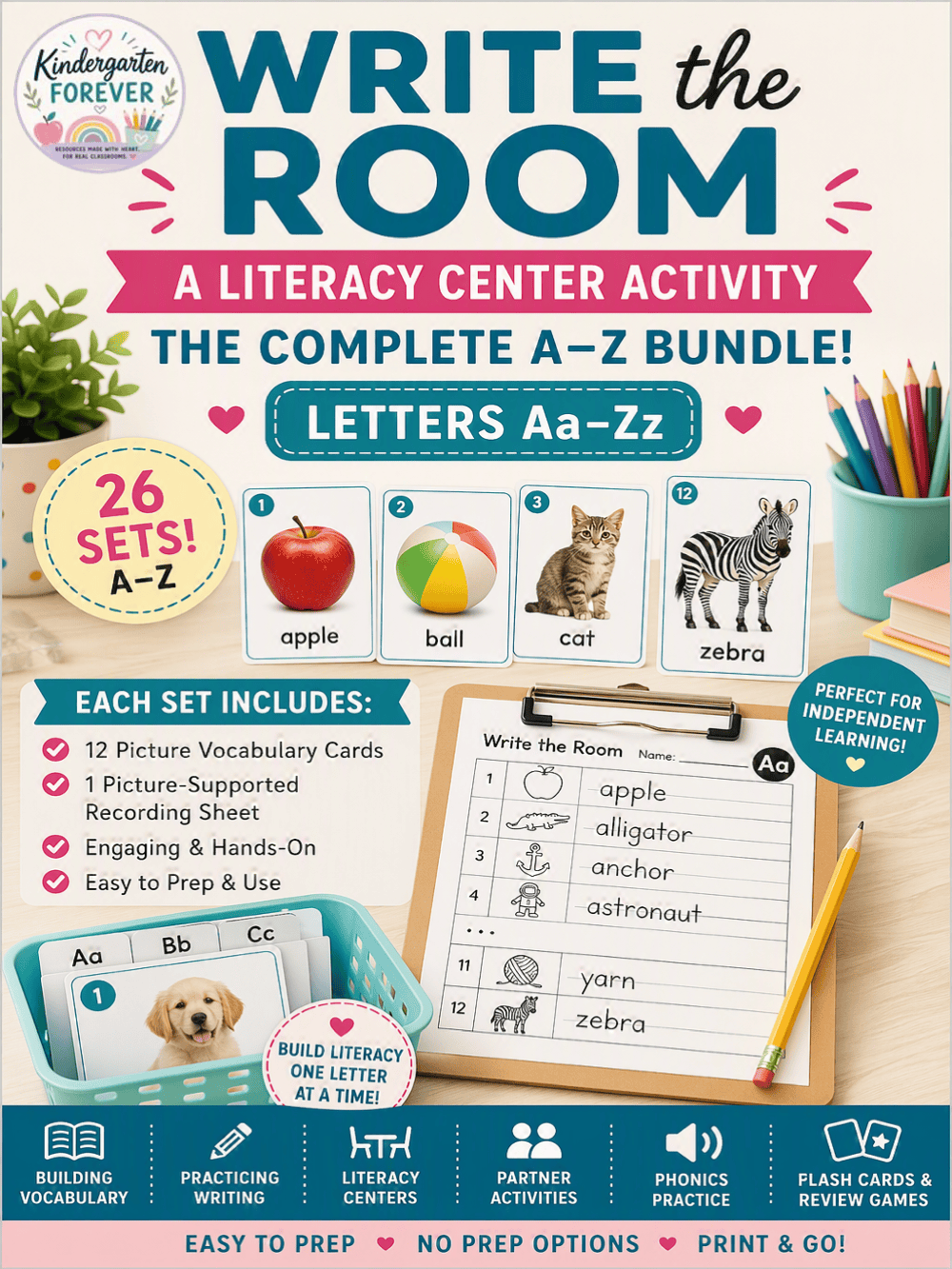
Write the Room A-Z - Full alphabet bundle Write the Room Activities

🔤 A-Z Write the Room Bundle

Build alphabet knowledge and early literacy skills with an engaging collection of alphabet-focused Write the Room activities. With a set for letters A-Z, it doesn’t matter which order you teach the letters to your class. The images focus on the beginning sounds for each letter – except X, where we use endings too 😉 With realistic pictures, your little learners will love this set; it will make your classroom feel modern and connected.

Write the Room Year-long Bundle - Celebrate the year

📅 Year-Long Write the Room Bundle

Keep literacy centers fresh all year long with seasonal and thematic Write the Room activities designed to support vocabulary growth, reading development, and independent learning throughout the school year. What’s included? Themed sets for the whole year: Back to School, Fall, Hallowe’en, Thanksgiving (appropriate for both the US and Canada), Winter, Christmas, New Year’s, Valentine’s Day, St. Patrick’s Day, Easter, Spring, and Summer.

🎉 Final Thoughts

Write the Room is more than just a literacy center. It is a purposeful learning experience that combines movement, hands-on practice, visual discrimination, vocabulary development, and handwriting skills in a way that students genuinely enjoy.

When children are engaged, moving, and actively participating, learning becomes meaningful.

That’s exactly why Write the Room continues to be one of the most effective and beloved literacy activities for kindergarten and first grade classrooms.

❓ Write the Room Activities FAQ

What are Write the Room activities?

Write the Room activities are interactive literacy center activities where students move around the classroom, find cards, and record words, letters, or answers on a recording sheet.

Are Write the Room activities good for kindergarten?

Yes! Write the Room activities for kindergarten are great for building letter recognition, beginning sounds, vocabulary, handwriting, visual discrimination, and independent work habits.

How do you use Write the Room in literacy centers?

Add the cards around the room, give students a recording sheet, clipboard, and pencil, and let them search, read, write, and record their answers independently.

What skills do Write the Room activities practice?

Write the Room can support alphabet practice, phonics skills, sight words, vocabulary development, handwriting, visual discrimination, and fine motor skills.

Teachers Are Solar Powered: Why Summer Is More Than Just a Break

Image for post attention
Teachers are solar powered

☀️ “Teachers are solar-powered… they recharge in the summer sun.”

As the saying goes, teachers are solar powered. If teachers are solar powered, summer is our charging season.

As teachers, we’re experts at giving.

We give our time, our energy, our patience, our creativity, and often a little piece of our hearts every single day. We spend months encouraging students, solving problems, planning lessons, and showing up—even on the days when our own batteries are running low.

That’s why summer is so important.

It’s not just a vacation. It’s a chance to recharge.

☀️ Why Teachers Need Time to Recharge

During the school year, life often feels like a race against the clock. Between lesson plans, grading, meetings, extracurriculars, and everyday responsibilities, there isn’t always much room left for ourselves.

Summer offers something many teachers desperately need: space.

  • Space to rest.
  • Space to breathe.
  • Space to enjoy simple things without watching the clock.

Whether that means reading a book on the patio, spending time with family, tackling a hobby, traveling somewhere new, or simply sleeping in without setting an alarm, every teacher’s version of recharging looks a little different.

🌻 Every Teacher Recharges Differently

Sometimes social media can make it feel like summer should be packed with adventures, home projects, professional development, and perfectly planned activities.

But here’s your reminder:

  • You don’t have to earn rest.
  • You already have.
  • If your perfect summer day includes a beach chair and a good book, that’s enough.
  • If it includes camping, road trips, gardening, or afternoons by the lake, that’s wonderful too.
  • And if your dream day is doing absolutely nothing at all, that’s perfectly okay.

☀️ Summer Helps Teachers Rediscover Themselves

One of the most beautiful parts of summer break is the opportunity to reconnect with the parts of ourselves that sometimes get pushed aside during the school year.

When we’re teaching, so much of our attention is focused on the needs of others. We spend our days supporting students, communicating with families, collaborating with colleagues, and making hundreds of decisions before lunch.

By the time summer arrives, many teachers realize they’ve been running on empty for weeks—or even months.

That’s why summer isn’t just about taking a break from teaching. It’s about making time for the things that bring us joy.

📚 Reading for pleasure instead of professional development.
☕ Enjoying a slow morning coffee without checking the clock.
🌿 Spending time outdoors and soaking up the sunshine.
🎨 Returning to hobbies and creative activities that make us feel like ourselves.
☀️ Summer Helps Teachers Rediscover Themselves

One of the most beautiful parts of summer break is the opportunity to reconnect with the parts of ourselves that sometimes get pushed aside during the school year.

When we’re teaching, so much of our attention is focused on the needs of others. We spend our days supporting students, communicating with families, collaborating with colleagues, and making hundreds of decisions before lunch.

By the time summer arrives, many teachers realize they’ve been running on empty for weeks—or even months.

That’s why summer isn’t just about taking a break from teaching. It’s about making time for the things that bring us joy.

📚 Reading for pleasure instead of professional development.
☕ Enjoying a slow morning coffee without checking the clock.
🌿 Spending time outdoors and soaking up the sunshine.
🎨 Returning to hobbies and creative activities that make us feel like ourselves.
🩷 Connecting with family and friends without feeling rushed.

If teachers are solar powered, these moments are part of the recharge process. They help restore the energy, creativity, and enthusiasm that we’ll bring back to our classrooms in September.

If teachers are solar powered, these moments are part of the recharge process. They help restore the energy, creativity, and enthusiasm that we’ll bring back to our classrooms in September.

✨ How Teachers Recharge During Summer Break

The idea that teachers are solar powered may sound funny, but many educators know how true it feels after months of classroom life. The best teachers know that you can’t pour from an empty cup.

Summer is an opportunity to refill yours.

The sunshine, slower mornings, laughter with friends, quiet moments, and simple pleasures all help prepare us for another year of making a difference in the lives of our students. So if you’re spending this summer resting, reading, travelling, or simply enjoying sunshine, remember that teachers are solar-powered—and recharging is part of the job.

Because when fall arrives, we’ll be ready to do what we do best.

But for now?

  • Relax.
  • Recharge.
  • Enjoy some well-deserved “you” time.

You’ve earned it.

✨ If organizing is your idea of self-care, take a peek at my store for teacher-tested resources, time-saving tools, and low-prep activities to help you start the school year feeling ready. 📚☀️

We’d Love to Know…

✨ What does your perfect teacher summer day look like?

Is it:

  • A good book and an iced coffee?
  • A day at the beach?
  • A family adventure?
  • Gardening in the sunshine?
  • Sleeping in with nowhere to be?

Share your perfect summer day in the comments—we’d love to hear how you’re recharging this summer! ☀️🍉📚

✏️Ontario Teacher Communication Book: The 1 Amazing Organization Tool I Can’t Teach Without

🍎 Every teacher has that one resource.

Not the flashy one that gets all the attention. Not the newest trend. Not the resource that looks the prettiest on social media.

🩷 I’m talking about the tool you reach for every single day without even thinking about it.

For me, that resource is my Ontario Teacher Communication Book. This Ontario Teacher Communication Book has become the organizational tool I rely on most throughout the school year.. In fact, it’s so useful that former teaching partners still message me every year asking if the updated version is ready. And honestly? I completely understand why.

✨ Why My Ontario Teacher Communication Book Became Essential

When people first see the communication book, they often assume it’s just a planner.

But it’s so much more than that.

It started as a practical solution for a very real classroom challenge: keeping multiple educators on the same page.

If you teach in Ontario Kindergarten, you know exactly what I mean. Most Kindergarten classrooms have two educators working together—an Ontario Certified Teacher (OCT) and an Early Childhood Educator (ECE). There are countless conversations happening throughout the day, and important information can easily get lost between planning periods, meetings, student support discussions, yard duty schedules, and the everyday busyness of teaching.

💡 I needed one place where everything could live.

So I created it.

👩‍🏫 More Than Just an Ontario Resource

While I call it an Ontario Teacher Communication Book, this teacher communication book has become a favourite among teaching partners, shared classrooms, and support teams alike.

It works for:

✅ Teaching partners
✅ OCT and ECE teams
✅ Job-share teachers
✅ Shared classrooms
✅ Resource and support staff
✅ Administrators
✅ Educational assistants
✅ Homeschool co-op programs
✅ Any educator who likes having information written down in one place

✨ Because the truth is simple:

The more people involved, the more important communication becomes.

🗂️ Why We Still Love Paper

We live in a world full of digital tools. And I use plenty of them. But there is something powerful about having a communication book sitting on a desk, open and ready to use.

❌ No tabs.
❌ No notifications.
❌ No searching through emails.
❌ No wondering where that important note was saved.

Instead, you have one reliable place to record:

✅ Student updates
✅ Parent communication notes
✅ Team reminders
✅ Supply needs
✅ Assessment reminders
✅ Important dates

✨ Sometimes the simplest systems are the ones that actually last.

🤦‍♀️ For Teachers Who Forget Everything They Don’t Write Down

Let’s be honest. Most teachers are juggling about a hundred things before 9:00 a.m.
🙋‍♀️ I am absolutely one of those people who needs to write something down or risk forgetting it entirely.
A quick note during a busy morning becomes a lifesaver later in the day.

Instead of trying to remember:

“Didn’t we talk about that yesterday?”
“Who was supposed to follow up on that?”
“Where did I write that information?”

✅ Everything is already documented in one consistent location.

📅 The Annual Update Teachers Wait For

One of my favourite parts about this resource is hearing from educators who have made it part of their yearly routine.

Every year, educators return looking for the newest edition of the Ontario Teacher Communication Book with updated calendars and important school dates.

🩷 Some have used it for years.

🩷 Others were introduced to it by a colleague and now can’t imagine starting a school year without it.

There is something incredibly rewarding about creating a resource that quietly supports teachers behind the scenes every single day.

It may not be the most exciting classroom purchase you’ll make.

✨ But it just might become the most-used.

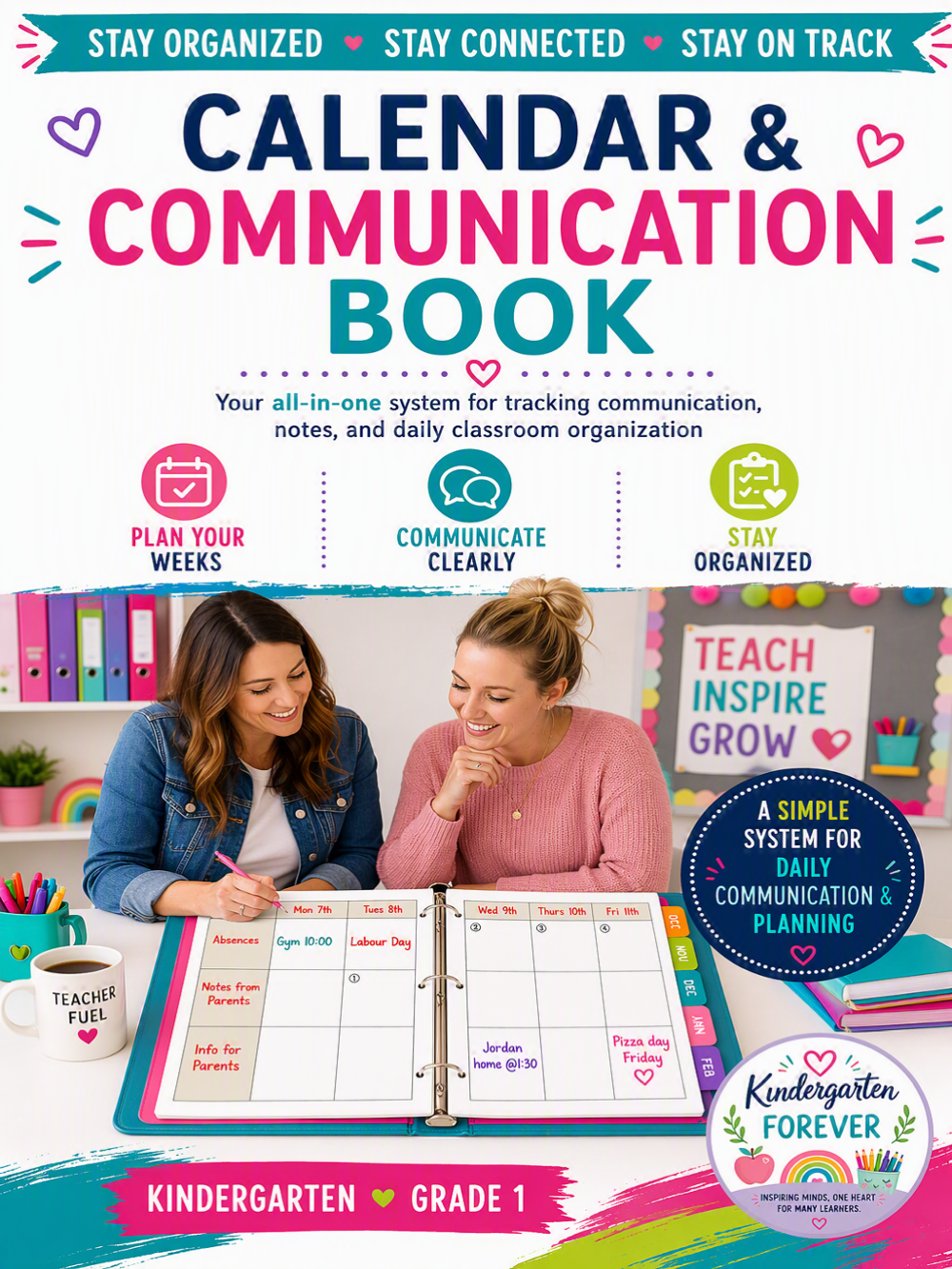
Ontario Teacher Communication Book

🍎 The Resource I Reach For Every Day

If I had to choose one organizational tool, my Ontario Teacher Communication Book would be it.

✅ Keeps teaching teams connected
✅ Reduces missed information
✅ Supports smooth classroom organization
✅ Helps busy educators keep track of everything that matters

💡 Not bad for a resource that most people never knew they needed.

Take a look at the Ontario Teacher Communication Book here:
📖 https://www.teacherspayteachers.com/Product/Ontario-Teacher-Communication-Book-Calendar-2026-27-Yearly-Update-Included-2750640

📅 One purchase = free updated editions every school year, forever! ✨

🩷 You might just discover your new favourite everyday teaching tool.

If you’re looking for an Ontario Teacher Communication Book that supports communication, organization, planning, and collaboration, this resource may be exactly what your teaching team needs.

The Kindergarten Forever Blog Is Back — Plus a Double Savings Treat!

sale ad

A Fresh Start for the Blog + A Bonus Savings Event!

It’s been a while…

Okay, it’s been 11 years. 😅

But the Kindergarten Forever Blog is officially back, and I couldn’t be more excited to welcome you here again!

If you’re a fellow Kindergarten educator, you know how quickly the years can fly by. One minute you’re introducing letter sounds and setting up dramatic play centres, and the next you’re realizing the blog you started in the early 2010s has been patiently waiting for a fresh new chapter.

So hello again! 👋💖

I’m the creator behind Kindergarten Forever, and I’m thrilled to bring this space back to life with practical, play-based ideas, Kindergarten support, classroom inspiration, and resources designed to make your teaching life just a little bit easier.

And what better way to celebrate than with a sale?


sale ad

🎉 Double Savings Event — Now Until July 15 🎉

To kick off this exciting new beginning, I’m offering a special Double Savings promotion for both longtime followers and new friends discovering Kindergarten Forever for the very first time.

🛍️ Followers Save 5%

Already following my Teachers Pay Teachers store? You’ll automatically receive 5% off all new releases.

💖 First-Time Buyers Save 5% Too

New to Kindergarten Forever? Welcome! You can also enjoy 5% off during this promotion—no code needed.

It’s my small way of saying thank you for being here and supporting resources created specifically for Kindergarten classrooms.

👉 Browse the Full Store Here:
Kindergarten Forever Teachers Pay Teachers Store
https://www.teacherspayteachers.com/store/kindergarten-forever


🌱 What You Can Expect From the Blog

This refreshed blog will continue to focus on what matters most in Kindergarten:

✨ Play-based learning ideas you can use right away
✨ Ontario Kindergarten-aligned teaching support
✨ Classroom-tested routines and strategies
✨ Literacy and numeracy inspiration
✨ Resource spotlights and teacher tips
✨ Short, practical posts (because teachers are busy!)

My goal is to create a space where you can quickly find ideas, inspiration, and ready-to-use solutions that support both you and your students.


📚 Freshly Updated Resources Available During the Sale

Several Kindergarten Forever favorites have recently been refreshed and updated. If you’ve been looking for classroom-ready resources, now is the perfect time to explore them!

✏️ Cursive Writing Practice Pages A–Z

Support letter formation and handwriting development with engaging cursive practice pages designed for young learners.

👉 Cursive Writing Practice Pages | A-Z Handwiting Worksheets and Letter Formation


🔤 Beginning Sounds Cut & Paste Worksheets

Build foundational phonics skills with hands-on activities that help students identify and practice beginning sounds from A–Z.
👉 Beginning Sounds Cut and Paste Worksheets | A-Z Phonics Pages for Kindergarten


🔺 2D & 3D Shapes Worksheets & Anchor Charts

Help students explore geometry concepts through engaging worksheets, anchor charts, and hands-on shape activities perfect for Kindergarten through Grade 3.
👉 2D and 3D Shape Worksheets and Anchor Charts | K-3 Geometry Activities


🍎 Ontario Kindergarten Planning Bundle (Updated for 2026)

A collection of three essential planning tools designed specifically for Ontario Kindergarten educators and aligned with current program expectations.
👉 Ontario Kindergarten Planing Bundle – Updated for 2026

💖 Thanks for Being Here

Whether you’ve been following Kindergarten Forever for years or you’ve just discovered this community today, thank you for stopping by.

After 11 years away from blogging, it feels wonderful to reopen this little corner of the internet and reconnect with educators who believe in meaningful, engaging early learning experiences.

Be sure to take advantage of the Double Savings Event before July 15, browse the newly updated resources, and check back soon for fresh ideas and classroom inspiration.

I can’t wait to share what comes next! 🌱✨

Happy teaching,

– Kindergarten Forever 🌈💕

Freezing in February!

I know, I live in Canada.  I’m supposed to be used to this weather, but this is truly crazy!!!  Today, the temperature with the wind feels like -40C.  For those of you in the USA, that also means -40F.  The point at which our thermometers meet.  The sun is shining with deception.  It is no match for the wind.  Skin will freeze in minutes.

So, I decided to ditch the winter and think spring!  I made a bundle of 6 spring products and that didn’t warm me up enough, so I am making some summer items!  I don’t know if they will sell, but they make me feel better on this cold day.

How do you stay warm?

✓✓✓✓✓✓✓✓Links to the Spring Series ✓✓✓✓✓✓✓

Slide01
Slide01
Slide01
Slide01
Slide01
Slide01
Slide1

📋 Kindergarten Assessment Documentation Made Simple

Kindergarten assessment documentation is one of the most important—and often most challenging—parts of teaching in an early years classroom.

Between observing play, recording anecdotal notes, taking photos, assessing learning, and preparing report cards, it’s easy to become overwhelmed by paperwork and scattered notes. Effective kindergarten assessment documentation helps educators track student growth, collect evidence of learning, and make informed instructional decisions throughout the school year.

Over the years, I’ve experimented with countless ways to document student learning. I’ve used sticky notes, notebooks, clipboards, binders, and digital tools. While all of these methods have their place, I was always searching for a system that would make kindergarten assessment more organized, efficient, and manageable.

That’s what inspired me to create my At-A-Glance Kindergarten Assessment Tracking System, a practical resource designed to help teachers collect, organize, and reference evidence of learning with confidence.

📸 Capturing Evidence of Learning Throughout the Day

One of the biggest challenges in kindergarten assessment documentation is collecting meaningful evidence while actively teaching and supporting students. Learning happens throughout the day—in conversations, play-based learning experiences, small-group instruction, independent activities, and classroom routines.

Having a simple system for recording observations makes it easier to capture important learning moments as they occur. Rather than trying to remember details later, educators can quickly document student thinking, skills, accomplishments, and next steps.

When assessment tools are aligned with the Ontario Kindergarten Curriculum (2026), teachers can more easily connect observations to curriculum expectations while building a comprehensive picture of each child’s growth, development, and achievement throughout the school year.

🍎 A Simple Way to Track Student Learning

That’s why I created my At-A-Glance Kindergarten Assessment Tracking System.

Designed to help teachers collect evidence of learning throughout the year, these tracking sheets provide an organized place to record observations, anecdotal notes, and assessment data for every student.

Instead of searching through piles of papers or sticky notes, you can keep assessment information in one easy-to-reference location while documenting learning as it happens.

Kindergarten Assessment Documentation - 2026 Ontario Kindergarten Expections Tracking Sheets

📚 Aligned with the Ontario Kindergarten Curriculum (2026)

The updated version of this resource has been designed to support the Ontario Kindergarten Curriculum (2026).

The tracking sheets align with the four curriculum frames:

✅ Foundations of Language and Mathematics
✅ Problem Solving and Innovating
✅ Self-Regulation and Well-Being
✅ Belonging and Contributing

This makes it easier to collect meaningful assessment evidence while monitoring student growth across all areas of the curriculum.

🌟 Why Documentation Matters in Kindergarten

Strong kindergarten assessment practices help educators:

  • Track student progress over time
  • Inform future instruction
  • Support report card writing
  • Identify student strengths and needs
  • Collect evidence of learning
  • Communicate growth with families and administrators
  • Make learning visible within a play-based classroom

In Kindergarten, learning often happens through conversations, exploration, inquiry, and play. Documentation helps capture those important moments that might otherwise be forgotten.

✏️ Designed for Busy Kindergarten Teachers

This resource was created by a teacher who understands the realities of a busy classroom.

The goal is simple: provide a practical system for organizing observations, tracking curriculum expectations, and making kindergarten assessment documentation more efficient.

Whether you’re collecting anecdotal notes during center time, recording observations during small-group instruction, or preparing for reporting periods, having a streamlined tracking system can save valuable time while reducing stress.

💕 Making Assessment More Manageable

Assessment doesn’t have to mean carrying stacks of sticky notes or trying to remember observations at the end of the day.

With an organized tracking system and curriculum-aligned assessment tools, you can spend less time managing paperwork and more time focusing on what matters most—supporting student learning and growth.

👉 Explore the updated Ontario Kindergarten Curriculum 2026 Assessment Tracking Resource and discover a simpler way to document learning throughout the school year.

School is Closed! Best Parody Ever!

Living in a very snowy part of Ontario, Canada, we get more than our share of the white stuff.  While it is too hazardous many days for the busses to travel, the majority of our school population walks to school, we we are almost never “closed”.  It has only happened once in my career and it was because of a really nasty storm

However, I love this parody for two reasons.  #1 – I’m always making an impromptu “Let It Go” parody on almost any subject with my students and #2 – I think it really captures the wonderment for everyone when school is closed!

Please stay warm and enjoy this little gem:

Alphabet Learning

I remember when my daughter came home from her first day of Kindergarten.  She was so excited because her teacher had made a song using all the letters she knew!  Of course it was the ABC song, but in our house we had never sung it.

My daughter learned her letters phonetically.  I did not stress the “names” of the letters, just the sounds they made.  This approach was reinforced in her Montessori school.  Consequently, she was reading when she was 3 years old and could sound out almost any word we threw at her.

My school board doesn’t teach phonetically, but I still try to throw it in with my students.  How were you taught the alphabet?  How are you teaching your children?

Here is an activity that can be used either way.  🙂

https://www.teacherspayteachers.com/Product/Alphabet-Card-Game-Letter-and-Phonemic-Awareness-for-Beginning-Sounds-1558815