Smooth Transitions in Kindergarten

Smooth Transitios in Kindergarten

The first weeks of school make it clear why smooth transitions in kindergarten matter so much. Children are stepping into an environment that feels completely different from anything they’ve experienced before. They’re not preschoolers anymore — but they’re still learning how to be students.

Suddenly, there are bells 🔔, lineups 🚶‍♀️🚶‍♂️, shared materials 🎨, and expectations that feel brand‑new. Even children with preschool experience must adjust to larger groups, multi‑step directions, and a faster pace. This is exactly why smooth transitions in kindergarten are essential: they help children understand what’s happening, what’s expected, and what comes next.

When transitions are predictable, children feel secure enough to participate, explore, and learn.

🔁 Why Predictability Supports Smooth Transitions in Kindergarten

Predictable routines are the foundation of smooth transitions in kindergarten. When children know what’s coming next, they can focus on learning instead of worrying. This sense of safety is essential for emotional regulation — a concept explored in Gentle Parenting & School Readiness (link to Sunday’s post).

Teachers who model calm 😌, use consistent cues, and keep transitions short and clear help children build independence. Predictability also reduces cognitive load. Instead of wondering what to do, children can focus on how to do it.

Smooth transitions in kindergarten support:

  • 🧠 Emotional regulation
  • 🚀 Task initiation
  • 🌟 Independence
  • 💛 Positive classroom climate

These skills shape the entire school year.

🖼️ Visual Cues Make Smooth Transitions in Kindergarten Easier

Visual cues are one of the most effective tools for achieving smooth transitions in kindergarten. Children entering school may not yet be reading, but they can absolutely interpret pictures, colors, and symbols. Visual organization helps them understand expectations without relying solely on verbal instructions.

Editable labels help teachers to foster smooth transitions

Picture labels 🏷️, color‑coded bins 🟦🟧, and illustrated schedules 📅 allow children to see what comes next. These cues reduce repeated reminders, support independence, and help students navigate the classroom confidently.

Pro Tip: A cohesive classroom gives children confidence that they know where they should be putting away materials, mail bags, folders, etc. Try our Editable labels to help make smooth transitions in kindergarten easier, reduce transition time, and help children feel ownership over their learning environment. They also save teachers HOURS ⏳ — a huge win during back‑to‑school season.

🎯 Setting Realistic Expectations for Smooth Transitions in Kindergarten

Kindergarteners arrive with preschool experience, but this environment is different. They are learning to navigate shared spaces, follow multi‑step directions, and manage emotions in a larger group. Setting realistic expectations helps children feel capable rather than overwhelmed — and supports smooth transitions in kindergarten.

Start with small, gentle transitions:

  • 🗣️ Use clear, simple language during transitions.
  • 🖼️ Offer visual reminders for cleanup, lining up, and centers.
  • 💬 Reinforce routines with positive language and predictable timing.
  • ⏱️ Keep transitions short and consistent.
  • 😌 Model calm behavior — children borrow your regulation.

These strategies bridge the gap between preschool familiarity and kindergarten structure. They also align beautifully with gentle parenting principles, where connection and boundaries work together to support emotional growth.

🏡 Families Can Support Smooth Transitions in Kindergarten

Smooth transitions don’t start or stop at the classroom door. Families can mirror these routines at home — using gentle parenting strategies to support consistency. When home and school routines align, children feel more secure and confident.

If you are looking for ways to support your preschooler in their smooth transition to kindergarten, you may want to strt with our Gentle Parenting & School Readiness article for ideas on how connection, predictability, and emotional safety support school success.

🌟 Key Takeaway

Smooth transitions in kindergarten aren’t just about moving from one activity to another — they’re about helping children feel safe, capable, and connected. When routines are predictable and visually supported, both teachers and students thrive.

Gentle Parenting in the Classroom: 5 Insights for Parents and Teachers

Gentle parenting has reshaped early childhood over the past decade. Its emphasis on connection, emotional validation, and respectful communication has offered families a compassionate alternative to punitive discipline. Many of these ideas are deeply supportive and developmentally sound.

But as more children raised with gentle parenting enter Kindergarten, teachers are noticing a shift. A growing number of students arrive at school expecting negotiation, choice, and extended dialogue around every request. This isn’t because gentle parenting is “wrong.” It’s because gentle parenting in the classroom functions very differently than gentle parenting at home.

This post explores why the mismatch is happening, what teachers are seeing, and how both parents and educators can work together to support children through the transition.

Gentle Parenting in the classroom - love and limits

💛 What Gentle Parenting Intends to Do

At its best, gentle parenting mirrors authoritative parenting—warm, responsive, and structured. Research consistently shows that this combination leads to stronger emotional regulation, better academic outcomes, and healthier peer relationships.

A helpful overview of parenting styles and why they matter can be found here: https://www.verywellmind.com/parenting-styles-2795072

When gentle parenting includes clear limits, predictable routines, and consistent follow‑through, children thrive.

📱 Where Gentle Parenting Drifts on Social Media

The challenge isn’t the philosophy—it’s the trend. On TikTok, Instagram, and parenting blogs, gentle parenting is often presented as endless empathy, negotiation, and calm conversation. Boundaries are softened or removed entirely.

This drift can unintentionally resemble permissive parenting, a style linked to:

  • difficulty with frustration tolerance
  • challenges with compliance
  • emotional dysregulation
  • negotiation during simple routines

Zero-to-Three has a great article about the buzzwords of gentle parenting. You can read it here: https://www.zerotothree.org/resource/distillation/buzzwords-explained-gentle-parenting/

When boundaries are inconsistent or negotiable, children may struggle in environments where expectations are shared, predictable, and non‑negotiable.

Gentle Parenting in the Classroom - Setting expectations with love and intention

🚸 What Teachers Are Seeing

Teachers across North America report similar patterns among children raised with the trend version of gentle parenting:

  • Negotiating every request (“I don’t want to,” “Can I do it later?”)
  • Difficulty accepting ‘no,’ ‘stop,’ or ‘it’s time to…’
  • Assuming all tasks have choices
  • Emotional dysregulation during transitions
  • Low tolerance for adult‑led routines
  • High verbal debate during simple instructions

In a home with one or two children, these negotiations can be manageable—even relationship‑building. In a classroom of 30+ students, they quickly become overwhelming.

This is the heart of the issue: gentle parenting in the classroom requires a different balance than gentle parenting at home.

🌱 Why This Matters for School Readiness

School readiness isn’t about knowing letters or numbers — it’s about being able to participate in a group learning environment. When children arrive expecting negotiation, extended dialogue, or individualized pacing, they struggle with the core skills Kindergarten requires:

  • stopping a preferred activity
  • following shared routines
  • transitioning with the group
  • tolerating limits
  • managing frustration without one‑on‑one adult coaching

Gentle parenting builds emotional awareness, but school readiness requires emotional flexibility — the ability to shift, adapt, and follow expectations even when it’s not preferred.

This is where the mismatch becomes most visible.

🧠 Why This Happens: What Research Shows

Two well‑established findings help explain why the gentle‑to‑permissive drift shows up so strongly in classrooms:

1. Attention During Misbehavior Reinforces the Behavior

Long conversations during tantrums or refusals provide high levels of attention. Behavioral science shows that attention—even calm, empathetic attention—can reinforce the behaviour.

The Centre on the Developing Child at Harvard University talks about executive function and emotional development here: https://developingchild.harvard.edu/science/key-concepts/executive-function/

2. Inconsistent Boundaries Create Confusion

Children thrive on predictable limits. When boundaries shift based on adult energy or emotional bandwidth, children struggle to understand when expectations apply.

The Child Mind Institute outlines how consistent limits support emotional regulation: https://childmind.org/article/teaching-kids-boundaries-empathy/

These patterns don’t make children “bad.” They simply mean children are practicing one set of norms at home and encountering a very different set at school.

🏫 Why Gentle Parenting in the Classroom Feels Different

A Kindergarten classroom is a micro‑community. It relies on:

  • shared materials
  • predictable routines
  • time‑bound transitions
  • safety protocols
  • collective cooperation

Teachers cannot negotiate every request. Teachers cannot offer endless choices. Teachers cannot pause instruction for extended emotional processing.

Even the gentlest, most play‑based classroom requires:

  • clear limits
  • adult‑led transitions
  • non‑negotiable safety routines
  • group compliance for the good of the whole

The Ontario Kindergarten Program emphasizes the importance of self‑regulation, routines, and co‑regulation within group settings: https://www.ontario.ca/document/ontario-kindergarten-program

This is not authoritarian. It’s functional—and developmentally appropriate.

💛 What Gentle Parenting Gets Right

It’s important to acknowledge that gentle parenting has tremendous strengths. Children raised with connection‑based parenting often enter Kindergarten with:

  • strong emotional vocabulary
  • comfort seeking help from adults
  • healthy attachment patterns
  • empathy for peers
  • the ability to name feelings

These are powerful foundations. The challenge isn’t the philosophy — it’s the implementation drift that happens when boundaries fade.

This balanced framing helps avoid parent defensiveness and positions you as a thoughtful, research‑aligned educator.

🌱 How Teachers Can Support Children Raised with Gentle Parenting

These strategies help bridge home norms and classroom expectations while maintaining warmth and connection.

1. Use predictable, consistent routines

Children who are used to negotiation thrive when transitions follow a clear pattern.

2. Offer structured choices

Instead of open‑ended negotiation, provide two teacher‑approved options.

3. Use calm, brief language during dysregulation

Avoid long explanations during refusal or upset; save conversation for after regulation.

4. Model firm + warm boundaries

“I hear you. It’s still time to clean up.” This mirrors authoritative parenting and supports emotional safety.

5. Teach group‑based expectations explicitly

Many children simply haven’t practiced these skills at home.

For more strategies that support routines, boundaries, and co‑regulation in early learning, visit the Classroom Management page.

🌼 How Parents Can Support the Transition to School

Parents can maintain gentle parenting values while preparing children for the realities of group learning.

1. Practice non‑negotiable routines at home

Choose one or two daily tasks that are consistent and predictable.

2. Use short, clear directions

Children benefit from hearing simple instructions without extended reasoning.

3. Introduce “school‑like” transitions

Timers, cleanup routines, and shared responsibilities build readiness.

4. Teach frustration tolerance

Small moments of “waiting,” “trying again,” or “not getting your way” build resilience.

5. Explain the difference between home and school

Children do better when they understand that classrooms have shared rules.

🚦 Why Transitions Are the Breaking Point

If there’s one place where gentle‑parenting drift shows up most clearly, it’s transitions.

Transitions require children to:

  • stop a preferred activity
  • shift attention
  • follow a multi‑step direction
  • regulate emotions
  • move with a group

Children who are used to extended negotiation or individualized pacing often find transitions overwhelming. This is why teachers see the most dysregulation during:

  • cleanup
  • moving to carpet
  • lining up
  • switching centres
  • coming inside from recess

💬 A Gentle Closing Thought

Most parents are doing the best they can with the information they have. Most teachers are doing the best they can with the children in front of them. The tension between gentle parenting and classroom expectations isn’t a failure — it’s a signal.

Children need both compassion and boundaries. Both validation and limits. Both negotiation and non‑negotiable expectations.

When home and school work together, children develop the resilience, flexibility, and self‑regulation they need to thrive — not just at home, but in every community they join.

The Gentle Art of Easing Into Summer Planning in 5 Steps

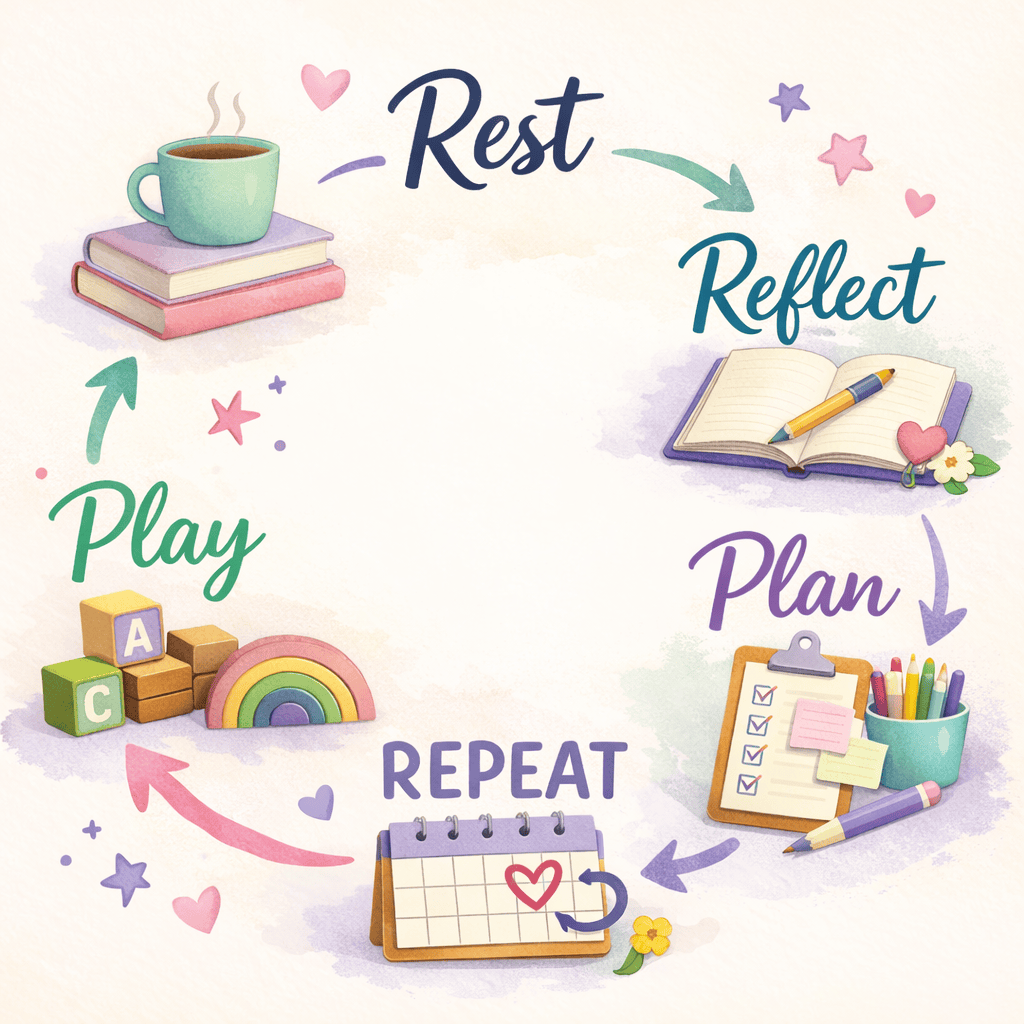
Summer Planning:  Play, Rest, Reflect, Plan, Repeat
Summer Planning – A Cycle for Balance and Renewal

A teacher’s rhythm for balance and renewal.

Summer planning doesn’t have to feel heavy, rushed, or guilt‑filled. For many teachers, the tension is real: you want to rest, but you also want to feel prepared. You want to enjoy your summer, but you also want September to feel smooth and intentional.

This is exactly why a gentle summer planning cycle matters. It’s not about doing more — it’s about doing what nourishes your mind, your heart, and your teaching practice.

The cycle is simple: Rest → Reflect → Plan → Play → Repeat. But its impact is profound.


🌿 1. Rest — Rest your mind and body. You’ve earned it.

Summer planning begins with rest — real rest. Not the “I’m resting but still thinking about my classroom” kind. The deep, nervous‑system‑reset kind.

“Rest isn’t indulgent. It’s recovery.”

Teachers carry an emotional and cognitive load that most people never see. You’ve spent ten months making thousands of decisions, supporting dozens of little hearts, and adapting to constant change. Rest is not optional — it’s essential.

Let yourself sleep in. Let yourself sit quietly. Let yourself do nothing without guilt.

You’ve earned every moment.

💫 2. Reflect — Look back with gratitude. Celebrate wins and growth.

Once your mind has softened, reflection becomes possible.

Reflection is not about reliving stress or replaying mistakes. It’s about noticing what went well, what grew, and what mattered. Gratitude shifts your perspective from exhaustion to appreciation — and appreciation into wisdom.

“Reflection turns experience into insight.”

Think about:

  • A student who blossomed
  • A routine that finally clicked
  • A moment that reminded you why you teach

This gentle reflection becomes the foundation for meaningful summer planning.

🩵 3. Plan — Create with purpose and intention. Focus on what matters most.

Planning is often where teachers jump first — but when you begin after rest and reflection, your planning becomes clearer, calmer, and more intentional.

Summer planning doesn’t mean building your entire September. It means choosing what matters most.

Maybe it’s:

  • Refining your morning routine
  • Reorganizing your literacy centers
  • Mapping out your first two weeks
  • Preparing a few anchor activities

Purposeful planning is not about doing more — it’s about doing what aligns with your values, your students, and your energy.

“Plan from intention, not urgency.”

When you plan gently, your classroom becomes a reflection of your heart, not your stress.

🌸 4. Play — Make time for joy and the things that recharge your heart.

Play is the part teachers forget — but it’s essential to summer planning.

Joy isn’t separate from teaching; it fuels it.

Read for fun. Garden. Bake. Laugh. Move. Create. Explore.

“When you nourish your joy, you nourish your teaching.”

Play recharges the creativity and curiosity you’ll bring back to your students in September.

💖 5. Repeat — Return refreshed, inspired, and ready to make a difference.

The final step in summer planning is simply to repeat the cycle as needed.

Rest. Reflect. Plan. Play. Repeat.

This rhythm isn’t just for July — it’s a sustainable pattern you can return to throughout the year. When you honor this flow, you protect your energy, strengthen your purpose, and show up as the teacher your students need.

“Gentle planning builds sustainable teaching.”

Summer planning doesn’t have to be heavy. It can be gentle, meaningful, and restorative. When you follow this cycle, you enter September not drained, but grounded — not overwhelmed, but inspired.

Visit Kindergarten Forever for more gentle summer planning ideas, classroom inspiration, and resources created with heart.

Inspiring minds. One heart for many learners.

🛒 If you’re moving through your own gentle summer planning cycle — resting when you need to, reflecting when it feels right, and preparing only in small, manageable moments — you might appreciate having ready‑to‑use resources that lighten your load when September arrives. When you’re in the mood to browse, you can explore my Kindergarten Forever materials on Teachers Pay Teachers at www.teacherspayteachers.com/store/kindergarten-forever. Everything there is designed to support calm, confident planning without adding pressure to your summer.

Teachers Are Solar Powered: Why Summer Is More Than Just a Break

Teachers are solar powered

☀️ “Teachers are solar-powered… they recharge in the summer sun.”

As the saying goes, teachers are solar powered. If teachers are solar powered, summer is our charging season.

As teachers, we’re experts at giving.

We give our time, our energy, our patience, our creativity, and often a little piece of our hearts every single day. We spend months encouraging students, solving problems, planning lessons, and showing up—even on the days when our own batteries are running low.

That’s why summer is so important.

It’s not just a vacation. It’s a chance to recharge.

☀️ Why Teachers Need Time to Recharge

During the school year, life often feels like a race against the clock. Between lesson plans, grading, meetings, extracurriculars, and everyday responsibilities, there isn’t always much room left for ourselves.

Summer offers something many teachers desperately need: space.

  • Space to rest.
  • Space to breathe.
  • Space to enjoy simple things without watching the clock.

Whether that means reading a book on the patio, spending time with family, tackling a hobby, traveling somewhere new, or simply sleeping in without setting an alarm, every teacher’s version of recharging looks a little different.

🌻 Every Teacher Recharges Differently

Sometimes social media can make it feel like summer should be packed with adventures, home projects, professional development, and perfectly planned activities.

But here’s your reminder:

  • You don’t have to earn rest.
  • You already have.
  • If your perfect summer day includes a beach chair and a good book, that’s enough.
  • If it includes camping, road trips, gardening, or afternoons by the lake, that’s wonderful too.
  • And if your dream day is doing absolutely nothing at all, that’s perfectly okay.

☀️ Summer Helps Teachers Rediscover Themselves

One of the most beautiful parts of summer break is the opportunity to reconnect with the parts of ourselves that sometimes get pushed aside during the school year.

When we’re teaching, so much of our attention is focused on the needs of others. We spend our days supporting students, communicating with families, collaborating with colleagues, and making hundreds of decisions before lunch.

By the time summer arrives, many teachers realize they’ve been running on empty for weeks—or even months.

That’s why summer isn’t just about taking a break from teaching. It’s about making time for the things that bring us joy.

📚 Reading for pleasure instead of professional development.
☕ Enjoying a slow morning coffee without checking the clock.
🌿 Spending time outdoors and soaking up the sunshine.
🎨 Returning to hobbies and creative activities that make us feel like ourselves.
☀️ Summer Helps Teachers Rediscover Themselves

One of the most beautiful parts of summer break is the opportunity to reconnect with the parts of ourselves that sometimes get pushed aside during the school year.

When we’re teaching, so much of our attention is focused on the needs of others. We spend our days supporting students, communicating with families, collaborating with colleagues, and making hundreds of decisions before lunch.

By the time summer arrives, many teachers realize they’ve been running on empty for weeks—or even months.

That’s why summer isn’t just about taking a break from teaching. It’s about making time for the things that bring us joy.

📚 Reading for pleasure instead of professional development.
☕ Enjoying a slow morning coffee without checking the clock.
🌿 Spending time outdoors and soaking up the sunshine.
🎨 Returning to hobbies and creative activities that make us feel like ourselves.
🩷 Connecting with family and friends without feeling rushed.

If teachers are solar powered, these moments are part of the recharge process. They help restore the energy, creativity, and enthusiasm that we’ll bring back to our classrooms in September.

If teachers are solar powered, these moments are part of the recharge process. They help restore the energy, creativity, and enthusiasm that we’ll bring back to our classrooms in September.

✨ How Teachers Recharge During Summer Break

The idea that teachers are solar powered may sound funny, but many educators know how true it feels after months of classroom life. The best teachers know that you can’t pour from an empty cup.

Summer is an opportunity to refill yours.

The sunshine, slower mornings, laughter with friends, quiet moments, and simple pleasures all help prepare us for another year of making a difference in the lives of our students. So if you’re spending this summer resting, reading, travelling, or simply enjoying sunshine, remember that teachers are solar-powered—and recharging is part of the job.

Because when fall arrives, we’ll be ready to do what we do best.

But for now?

  • Relax.
  • Recharge.
  • Enjoy some well-deserved “you” time.

You’ve earned it.

✨ If organizing is your idea of self-care, take a peek at my store for teacher-tested resources, time-saving tools, and low-prep activities to help you start the school year feeling ready. 📚☀️

We’d Love to Know…

✨ What does your perfect teacher summer day look like?

Is it:

  • A good book and an iced coffee?
  • A day at the beach?
  • A family adventure?
  • Gardening in the sunshine?
  • Sleeping in with nowhere to be?

Share your perfect summer day in the comments—we’d love to hear how you’re recharging this summer! ☀️🍉📚

The Kindergarten Forever Blog Is Back — Plus a Double Savings Treat!

A Fresh Start for the Blog + A Bonus Savings Event!

It’s been a while…

Okay, it’s been 11 years. 😅

But the Kindergarten Forever Blog is officially back, and I couldn’t be more excited to welcome you here again!

If you’re a fellow Kindergarten educator, you know how quickly the years can fly by. One minute you’re introducing letter sounds and setting up dramatic play centres, and the next you’re realizing the blog you started in the early 2010s has been patiently waiting for a fresh new chapter.

So hello again! 👋💖

I’m the creator behind Kindergarten Forever, and I’m thrilled to bring this space back to life with practical, play-based ideas, Kindergarten support, classroom inspiration, and resources designed to make your teaching life just a little bit easier.

And what better way to celebrate than with a sale?


sale ad

🎉 Double Savings Event — Now Until July 15 🎉

To kick off this exciting new beginning, I’m offering a special Double Savings promotion for both longtime followers and new friends discovering Kindergarten Forever for the very first time.

🛍️ Followers Save 5%

Already following my Teachers Pay Teachers store? You’ll automatically receive 5% off all new releases.

💖 First-Time Buyers Save 5% Too

New to Kindergarten Forever? Welcome! You can also enjoy 5% off during this promotion—no code needed.

It’s my small way of saying thank you for being here and supporting resources created specifically for Kindergarten classrooms.

👉 Browse the Full Store Here:
Kindergarten Forever Teachers Pay Teachers Store
https://www.teacherspayteachers.com/store/kindergarten-forever


🌱 What You Can Expect From the Blog

This refreshed blog will continue to focus on what matters most in Kindergarten:

✨ Play-based learning ideas you can use right away
✨ Ontario Kindergarten-aligned teaching support
✨ Classroom-tested routines and strategies
✨ Literacy and numeracy inspiration
✨ Resource spotlights and teacher tips
✨ Short, practical posts (because teachers are busy!)

My goal is to create a space where you can quickly find ideas, inspiration, and ready-to-use solutions that support both you and your students.


📚 Freshly Updated Resources Available During the Sale

Several Kindergarten Forever favorites have recently been refreshed and updated. If you’ve been looking for classroom-ready resources, now is the perfect time to explore them!

✏️ Cursive Writing Practice Pages A–Z

Support letter formation and handwriting development with engaging cursive practice pages designed for young learners.

👉 Cursive Writing Practice Pages | A-Z Handwiting Worksheets and Letter Formation


🔤 Beginning Sounds Cut & Paste Worksheets

Build foundational phonics skills with hands-on activities that help students identify and practice beginning sounds from A–Z.
👉 Beginning Sounds Cut and Paste Worksheets | A-Z Phonics Pages for Kindergarten


🔺 2D & 3D Shapes Worksheets & Anchor Charts

Help students explore geometry concepts through engaging worksheets, anchor charts, and hands-on shape activities perfect for Kindergarten through Grade 3.
👉 2D and 3D Shape Worksheets and Anchor Charts | K-3 Geometry Activities


🍎 Ontario Kindergarten Planning Bundle (Updated for 2026)

A collection of three essential planning tools designed specifically for Ontario Kindergarten educators and aligned with current program expectations.
👉 Ontario Kindergarten Planing Bundle – Updated for 2026

💖 Thanks for Being Here

Whether you’ve been following Kindergarten Forever for years or you’ve just discovered this community today, thank you for stopping by.

After 11 years away from blogging, it feels wonderful to reopen this little corner of the internet and reconnect with educators who believe in meaningful, engaging early learning experiences.

Be sure to take advantage of the Double Savings Event before July 15, browse the newly updated resources, and check back soon for fresh ideas and classroom inspiration.

I can’t wait to share what comes next! 🌱✨

Happy teaching,

– Kindergarten Forever 🌈💕

School is Closed! Best Parody Ever!

Living in a very snowy part of Ontario, Canada, we get more than our share of the white stuff.  While it is too hazardous many days for the busses to travel, the majority of our school population walks to school, we we are almost never “closed”.  It has only happened once in my career and it was because of a really nasty storm

However, I love this parody for two reasons.  #1 – I’m always making an impromptu “Let It Go” parody on almost any subject with my students and #2 – I think it really captures the wonderment for everyone when school is closed!

Please stay warm and enjoy this little gem:

How to get FREE products on Teachers Pay Teachers

button1

I love TeachersPayTeachers!  I have done for years!  Only recently have I jumped on the selling side of things and I love how it works.  Recently, when talking with some colleagues, I found that most people didn’t know how easy it is to get the best products at a discount, or even FREE!

Every time you buy a product on TPT, they send you a little email to remind you to give feedback on the product.  What a nag that email is.  Most people put it in the trash, which is too bad because TPT is giving you $$$$ for your feedback.

When you leave feedback on a product, you earn TPT credits.  These credits can then be used like real money to offset the cost of future purchases.  Here’s how it works:

Earn TpT Credits for purchases on TpT. You get one TpT Credit for every $ you spend on TpT. Thing is, you only get the Credits after you Provide Feedback — both a fair rating and a fair comment — on the items that you purchase. We will round up for you, too! If you provide fair feedback on a $4.75 item, you will earn 5 credits. Every 100 Credits is worth $5 that you can apply towards future TpT purchases, but there is no need to wait until you have 100 to redeem them. 50 credits is worth $2.50, for example.

The program is retroactive to feedback provided on purchases since August 1, 2011.

How to Redeem TpT Credits
You can keep track of how many credits you have accrued here or on the top of the site after login. When you check out, you will be given the option of applying your TpT Credits to your purchase, thereby discounting your purchase price accordingly.

I LOVE getting paid for my opinion!  Don’t you?  So head on over to TPT, click on the “My Purchases” link and claim some cash by submitting feedback today!  The Sellers will thank you for it, and so will your wallet!


P.S. ~ A very special shout out to one of the talented artists on TeachersPayTeachers.  Krista Wallden generously allowed me to use her clipart on my TPT banners without the kind of visible credit you would expect when using clipart on a product for sale on TPT.  Without her talents, my products would be boring indeed.  Please visit her store here:  https://www.teacherspayteachers.com/Store/Krista-Wallden  Thanks Krista!